 Ab Aeterno – Aug 12, 2026
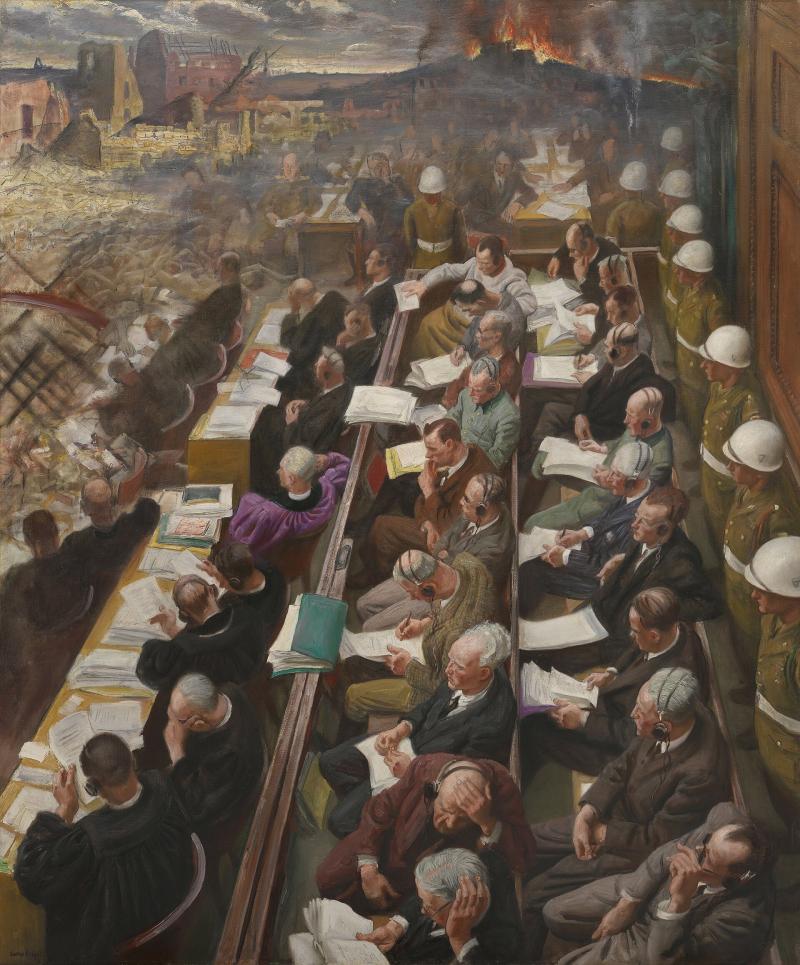
The Nuremberg Trial, 1946, by Laura Knight
The Nuremberg Trials interpreters enabled judges, prosecutors, defense attorneys, witnesses, and defendants to participate in an international legal proceeding conducted in English, French, Russian, and German.
Consecutive interpreting would have multiplied the duration of the trial. The alternative was a still-experimental simultaneous interpretation system operated by dozens of language professionals under intense technical, linguistic, and emotional pressure.
The trials did not invent simultaneous interpretation. They proved that it could operate for months, at scale, in a high-stakes international setting and helped clear the way for its adoption by the United Nations.
The main trial ran from November 20, 1945, to October 1, 1946, over 210 days. Judges and prosecutors represented four Allied powers, while the defendants and their attorneys communicated mainly in German. Testimony, objections, evidence, and decisions had to be accessible in all four official languages.
This was not merely logistical. The Charter of the International Military Tribunal and the defendants’ right to understand the proceedings required a reliable language system, and each judge needed to follow the other delegations. (Holocaust Encyclopedia)
Consecutive interpreting would have required most interventions to be repeated in the other languages. The National WWII Museum explains that this approach could have made the trial roughly four times longer.
With simultaneous interpreting, professionals listened, processed the message, and reproduced its meaning almost immediately. A brief delay remained necessary to understand each unit of meaning, but participants no longer had to wait for several consecutive versions of the same intervention.
Translation and interpreting performed complementary functions, but they were not the same activity.
Translation works mainly with written texts and normally allows research, terminology checks, and revision. At Nuremberg, translators processed indictments, evidence, rulings, judgments, and thousands of pages of legal documentation.
Interpreting works mainly with spoken communication. During the hearings, interpreters had to communicate meaning within seconds, without extended research or revision.
Although historical sources often use the phrase “simultaneous translation,” the more accurate term for oral communication is simultaneous interpretation or simultaneous interpreting.
The distinction remains relevant today. A legal proceeding may require professional interpreting and legal translation services for contracts, evidence, rulings, and supporting documents, but each service requires a different workflow and skill set.
No. Its technology and early experiments predated the trials by several decades.
During the 1920s, Edward Filene and Alan Gordon Finlay developed a system for transmitting interpreted speeches through microphones and headsets. IBM later modified the technology for international meetings in Geneva.
Some early systems relied on pretranslated, scripted speeches. They were not suited to spontaneous questions, objections, answers, and testimony.
Nuremberg’s innovation was to apply the method continuously to unscripted communication across four languages. Léon Dostert, a linguist and former interpreter for General Dwight Eisenhower, promoted the technology, participated in recruitment, and helped organize tests for prospective interpreters.
The most accurate conclusion is this: the Nuremberg Trials did not invent simultaneous interpretation, but they became its first major demonstration in a complex international legal proceeding.
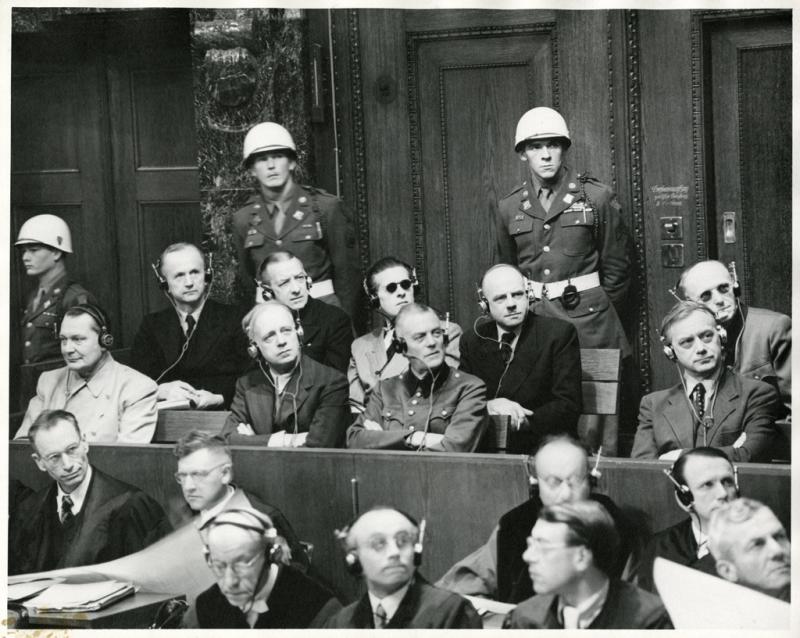
Defendants in the Main Nuremberg Trial
The system combined technology, human teams, speaker protocols, and constant supervision. Its success depended on every part of the operation working together.
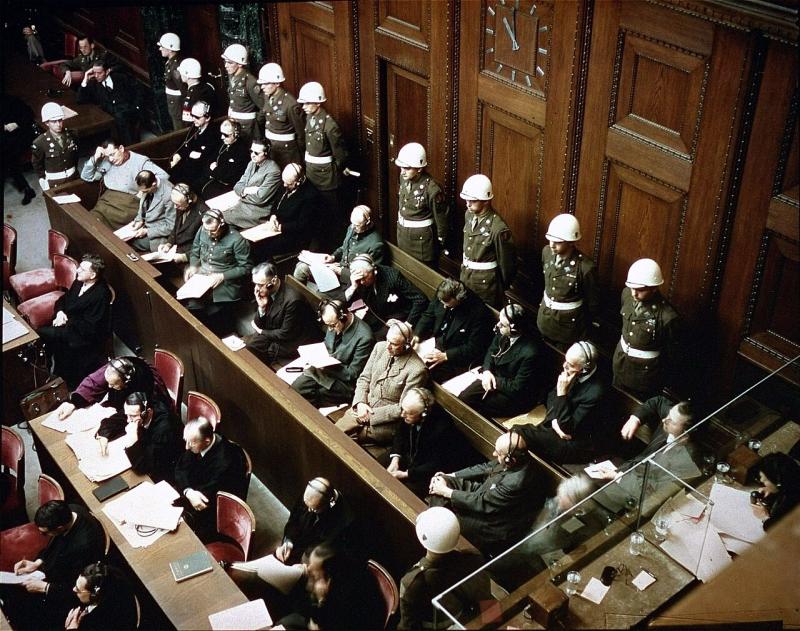
Participants could select one of five channels: the original speech, English, Russian, French, or German. Each seat had a headset and channel selector, allowing different parts of the courtroom to follow the same intervention at the same time.
Microphones served judges, witnesses, and speakers. The operation required about 600 headsets, installed shortly before the trial. Interpreters practiced through mock hearings while preparations continued.
The team responsible for simultaneous interpreting during the hearings consisted of 36 interpreters, organized into three groups of 12. One team worked in the courtroom, another remained available on standby and the third rested.
The figure of 108 refers to the broader language operation. PBS includes interpreters, translators, and stenographers in that total, with additional support for languages such as Polish and Yiddish. The two figures describe different parts of the system.
The enclosures let interpreters see judges, defendants, attorneys, and witnesses. Visual access helped identify speakers and interpret tone, gestures, and ambiguities.
Proceedings moved at approximately 60 words per minute. A yellow light instructed the speaker to slow down. A red light required the speaker to stop because part of the message needed to be repeated, or a technical or interpreting problem required an interruption.
The arrangement reflected a principle that remains valid: interpretation quality also depends on clear audio, manageable speaking speeds, orderly turn-taking, suitable equipment, and cooperation from participants.
Original statements and interpreted versions were recorded, while stenographers prepared transcripts for review. The proceedings produced 42 published transcript volumes and became known as the “six-million-word trial,” according to Holocaust Centre North.
The scale of the record explains why written translation was as important as oral interpretation. Interpreters enabled immediate communication, while translators and revisers helped preserve a multilingual legal record.
Peter Less was one of the pioneering interpreters at Nuremberg. He had escaped Nazi Germany and reached Switzerland in the early 1940s. His father, mother, sister, and grandmother remained in Germany and died as a result of Nazi persecution.
Less studied at the School of Conference Interpreters in Geneva, where training focused mainly on consecutive interpreting. In 1946, at age 25, he joined the tribunal and interpreted from English into German. His work also included consecutive interpreting and written legal translation.
His experience raises one of the profession’s hardest questions: how can an interpreter faithfully communicate a message when both the speaker and the content provoke profound personal rejection?
Professional impartiality does not require approval or emotional detachment. It requires preserving meaning, avoiding personal additions, and not assuming the role of judge, prosecutor, or attorney.
One Trial, Four Languages chronicles the experiences of Peter Less and other Nuremberg interpreters. After the trials, Less moved to the United States and practiced law. In 2006 he received the Alexander Gode Medal from the American Translators Association.
The teams brought together refugees, survivors, military personnel, journalists, diplomats, and young multilingual professionals. Three stories illustrate the human dimension of the language operation:
Their biographies prevent the interpreters from being reduced to an anonymous group of bilingual professionals. Many were speaking in the first person about violence and persecution they had experienced directly.
Court interpreting at Nuremberg required more than fluency in two languages. Interpreters needed knowledge of legal procedures, military structures, political institutions, administrative terminology, and the vocabulary of the Nazi regime.
The principal challenges included:
These challenges explain why subject-matter expertise matters. A person may speak two languages fluently and still lack the preparation required for specialized legal interpreting.
The same principle applies in high-risk technical settings. Ab Aeterno’s Spanish-language guide to interpretation in mines and operational safety examines another environment in which terminology, equipment, and clear communication carry serious consequences.
The success of the Nuremberg system changed the history of conference interpreting.
On December 7, 1946, the United Nations General Assembly adopted Resolution 75(I), authorizing the use and testing of a simultaneous interpretation system. On November 15, 1947, it adopted Resolution 152(II) on simultaneous interpretation.
The method initially faced resistance from consecutive interpreters, who feared that equipment could affect accuracy and remove useful pauses. Supporters emphasized more fluid debate, multilingual participation, shorter meetings, and lower costs.
The United Nations ultimately adopted the method. Modern practice still rests on the core actions identified by the European Commission: active listening, analysis, and reproduction.
Today’s conditions are different, but the same organizational principles remain relevant to conferences, business meetings, legal proceedings, and international events.
Documentation is also part of the system. In technical projects, interpretation may need to be coordinated with the accurate translation of manuals, procedures, and supporting materials.
The central lesson is simple: interpretation is not an accessory added at the end of planning. It is a coordinated service involving professionals, technology, preparation, logistics, and communication protocols.
They were multilingual professionals recruited to support the International Military Tribunal, including refugees, survivors, military personnel, journalists, diplomats, students, and language specialists.
The simultaneous interpreting team for the hearings included 36 interpreters in three groups of 12. The broader language operation involved approximately 108 professionals when translators, stenographers, and other personnel were included.
The four official languages were English, French, Russian, and German. The system provided one channel for the original speech and four interpreted channels.
No. Experimental systems existed before the trials. Nuremberg became the first major sustained application of simultaneous interpretation in a complex international legal proceeding involving spontaneous exchanges.
An interpreter works mainly with spoken communication and delivers the message in another language in real time or after a short pause. A translator works mainly with written documents and normally has time to consult sources and review the completed text.
They allowed every party to understand the proceedings without repeating each intervention consecutively in four languages. Their work made the international process viable and supported the defendants’ ability to understand the case.
Nuremberg demonstrated that multilingual communication can directly affect access to justice, participation, and understanding. It also showed that technology alone cannot overcome language barriers. IBM’s equipment required trained interpreters, translators, monitors, stenographers, technicians, reserve teams, documentation, and clear rules for speakers.
At Ab Aeterno, we coordinate professional interpretation services for meetings, conferences, legal proceedings, and specialized events. We assess the languages, subject matter, duration, format, technical conditions, and reference materials before assigning the team.
 Location