
 Ab Aeterno – Oct 19, 2026
A false cognate is a Spanish word that looks like an English one and means something else. The famous ones, like embarazada and embarrassed, announce the mistake and someone fixes it.
The dangerous ones produce a believable sentence: eventualmente, compromiso, actualmente. Those survive all the way into the finished document.
Do you need a translation rather than a vocabulary lesson? Send us the document and we'll quote it. If you work across both languages and want to understand the trap, read on: the full list is further down.
A false cognate is a word that looks similar in two languages and means something different. It is also called a false friend, a name that comes from a 1928 book written for translators, Les faux amis, by Maxime Koessler and Jules Derocquigny.
English and Spanish share thousands of words of Latin origin, and linguistics has carried the term false friend for nearly a century. That common inheritance is a real advantage: if you read English, you already recognize hospital, animal, natural, contrato, información. But the same inheritance produces traps, because two words can come from one root and then drift apart.
A true cognate is the opposite: similar form, same meaning. Doctor is doctor, familia is family, problema is problem. There are thousands of them, and they let you read more Spanish than you think.
Some endings are reliable:
The problem is that the pattern works so often that you stop checking. That is where the false ones get through.
Because English borrowed from Latin twice. First through Norman French after 1066, then from scholarly Latin during the Renaissance. Spanish descends from Latin directly. Many words reached both languages from the same source, at different moments and by different routes, and each one narrowed to a different sense.
Actually and actualmente both come from the Latin actualis. English kept the sense of "real, in fact"; Spanish kept the sense of "present, at this time." Neither language made a mistake. They diverged.
So false cognates are not errors in either language. They are history.
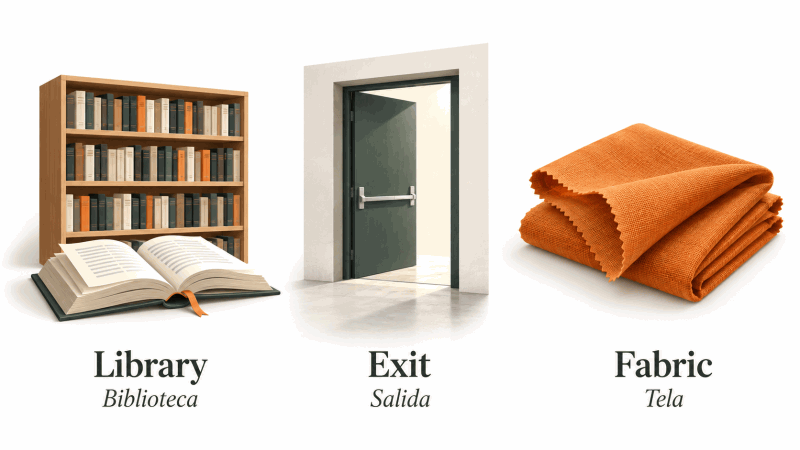
These appear on every list, which is exactly why they are the least dangerous.
These are the ones that matter. At Ab Aeterno Traductores, court-authorized translators in Mexico City, we ran the exercise in our own office: we went through a list of more than fifty pairs and marked the ones that actually reach us in real documents. The famous ones did not make the cut. These did.
They share one property. They do not produce an absurd sentence. They produce a believable sentence that says something else. Nobody catches them, because there is nothing visible to catch.
The most expensive pair on the list. In English, eventually means "in the end, sooner or later." In Spanish, eventualmente means "occasionally" or "possibly."
An email that reads eventualmente entregaremos el reporte says the report may arrive. Read as "we will eventually deliver the report," it says the report will arrive, sooner or later. A hedge turns into a commitment, or the reverse, and no word looks wrong.
The Real Academia Española, the institution that sets the standard for Spanish, is explicit about it: using eventualmente to mean "finally" is a censurable calque of English eventually. If your Spanish text means "in the end," the correct options are al final, con el tiempo or finalmente.
Actualmente means "currently, at present." Actually means "in fact, in reality," which in Spanish is en realidad or de hecho.
Actualmente es la directora states a fact about right now, and hints that things were different before. Read as "actually, she is the director," it becomes a correction of something just said. The sentence still reads naturally in both directions, which is the whole problem.
Compromiso is an obligation someone has taken on, which in English is a commitment. A compromise, in English, is an agreement where both sides give something up, which in Spanish is acuerdo mutuo or arreglo.
The difference matters in any negotiation. "We reached a compromise" says both parties conceded. Llegamos a un compromiso says someone took on an obligation. The English verb adds a third sense, that of putting something at risk, as in compromised security.
Asesor is someone who advises: an advisor or consultant. An assessor evaluates or appraises, which in Spanish is evaluador or valuador.
The difference is the function. An assessor judges what something is worth; an asesor tells you what to do about it. On an org chart, a résumé or a services proposal, those are not the same role.
Confidente is the person you tell what you tell no one else: a confidant. Confident means self- assured, which in Spanish is seguro de sí mismo.
One word describes an attitude, the other a relationship. In a recommendation letter, a performance review or a novel, mixing them changes what the text is about while the sentence still makes sense.
There is a third family that rarely appears on false-cognate lists, because these are not quite false cognates: one English word maps onto several Spanish words, and picking the wrong one is invisible.
Policy is política when it means a rule or guideline. It is póliza when it means an insurance contract. It has nothing to do with policía, which is police.
La política de la empresa and la póliza de la empresa are different documents with different consequences. One English word names both, and the dictionary does not decide which one you need. The document does.
Quote is citar and also cotizar. A quote can be a direct quotation or a price estimate. Cuota in Spanish is neither: it is a fee if it is what you pay, or a quota if it is what you are allotted.
"Send me the quote" asks for a price in a business conversation and for a quotation in an editorial one. Nobody writes it wrong. The context changes.

This is the list we use in the office, with the sense that causes the most confusion: the Spanish word, what it actually means, and the English word it resembles. The silent ones above belong to it as well.
We are professional translators in Mexico City, and we have worked since 2005 in Spanish, English, French, Portuguese, Italian and German. We handle official documents, technical manuals, academic texts, corporate materials and editorial content. False cognates do not respect subject matter: they show up in a contract, in a machine manual and on a restaurant menu.
Twenty years of documents produced four working rules:
That last rule is our process. Every project is analyzed by one translator, translated by a specialist in the subject matter and reviewed by a second translator before it goes out. Our work is to deliver a text faithful to the original in form and substance.

A cognate is a word two languages share with similar form and similar meaning, almost always because of a common origin. Contrato and contract are true cognates: you can translate one as the other without risk. The same goes for doctor, hotel, natural and información.
A false cognate keeps the resemblance in form and loses it in meaning. Librería is not a library, it is a bookstore. Éxito is not an exit, it is success.
There is a distinction worth adding that most lists skip. Some false cognates are loud and some are silent. The loud ones produce an absurd sentence and correct themselves. The silent ones produce a believable sentence that says something different, and those survive review: eventualmente, compromiso, actualmente, asesor.
If you are going to memorize a short list, memorize the second kind. The first kind defends itself.
A quick test tells you which one you are looking at: replace the word with the translation that seems obvious and read the sentence aloud. If it sounds ridiculous, it is a loud false cognate and it will not get far. If it sounds fine but the meaning shifts slightly, it is a silent one and it is worth verifying.
There is no settled number, and any exact figure you find is an editorial decision rather than a fact. It depends on what you count.
Common lists run between forty and a hundred pairs. The one in this article collects the pairs that show up most often in real documents. If you include partial false cognates — words that match in one sense and diverge in another, such as conductor or familiar — the count grows considerably. Add the specialized vocabulary of each field and no list can cover it.
Our practical advice is not to chase a complete list. Learn the mechanism instead: a word that looks very familiar and fits the sentence a little too neatly deserves a second look. With that habit you catch pairs you have never seen on any list.
The number that matters is your own. An architecture firm does not struggle with the same pairs as a pharmaceutical company, and the useful list is built from what appears in your own documents.
Because both words come from the Latin eventus and each language kept a different part of the meaning.
English took the idea of outcome: eventually is "in the end, sooner or later." Spanish took the idea of contingency: eventualmente is "occasionally" or "possibly."
In practice the senses are nearly opposite. "We will eventually sign" announces that the signature will happen. Eventualmente firmaremos announces that it might happen, or that it will happen from time to time. In a deadline, a budget or a delivery commitment, that difference is substantive.
The Real Academia Española treats the use of eventualmente to mean "finally" as a censurable calque from English. If your Spanish text means "in the end," use _al final, con el tiemp_o or finalmente.
Worth noting: the calque is already circulating. Eventualmente in the English sense turns up more and more in Spanish-language press and in corporate documents translated from English, and that frequency makes it harder to spot. It sounds like ordinary Spanish because many people now write it that way.
Yes, and they appear wherever two languages share roots. The closer the languages, the more of them there are.
Spanish and Portuguese have a remarkable number, precisely because the resemblance invites confidence: embaraçada in Portuguese means embarrassed, not pregnant, and oficina means workshop. Between Spanish and Italian, burro is butter and salire is to go up. Between Spanish and French, entendre means to hear, not to understand.
The phenomenon is not limited to Romance languages either. English and German have their own pairs: Gift in German means poison.
We work in six languages and the rule is the same in all of them. Resemblance is not evidence. When two words look alike across closely related languages, verification becomes more necessary, not less.
Between English and Spanish, the trap is also asymmetrical. A Spanish speaker stumbles over actually and library; an English speaker stumbles over embarazada and éxito. Each direction has its own list, and knowing one does not protect you from the other.
It catches the famous ones and misses the silent ones.
A translation engine handles embarazada and embarrassed reliably, because that error appears millions of times in its training data and the correction is learned. With eventualmente, policy or quote the result changes: the engine produces the statistically most frequent option, which is not always the one your text requires.
The underlying problem is that the machine does not know what your document is about or who will read it. Policy is translated differently in an HR manual and in an insurance contract, and that decision does not live in the word. It lives in the context.
One nuance is worth keeping in mind: engines improve quickly on the famous pairs and much more slowly on the silent ones, because a silent error is almost never flagged as an error in the texts they train on.
Our advice is to use machine translation to understand a text, not to publish one. For a document that will circulate with your name on it, human review is what separates a draft from a deliverable.
With a habit, not a list.
The habit is to doubt the easy words. Silent false cognates are not obscure terms: they are common words that fit the sentence a little too well. When a translation comes out effortlessly and the word closely resembles the original, that is the moment to stop.
Three concrete practices help. First, read the translated sentence as if you had never seen the original: if it means something slightly different from what you expected, check it. Second, look up the sense, not just the word; bilingual dictionaries offer several options and the first one is not always yours. Third, build your own list from the pairs that show up in your work, which will differ from the ones in this article.
A note on tools: shared glossaries help more than individual memory. If your team writes in two languages, a common document listing the pairs that have already caused trouble keeps each person from discovering them alone.
And for anything that will circulate, ask for a second reading. Nobody catches their own false cognates well.
False cognates are not a vocabulary problem. They are a confidence problem: the word looks so familiar that you stop checking, and the sentence that comes out reads perfectly.
At Ab Aeterno Traductores, court-authorized translators in Mexico City, we translate official, technical, academic and corporate documents in six languages, with a second translator reviewing every file before delivery. When a procedure calls for it, we provide certified translation by a perito traductor autorizado. We handle urgent requests when document length, language pair and team availability allow.
To request a quote, send us the complete document, the target language and your deadline. If your text is a manual or a spec sheet, see how we handle technical manual translation. For official documents that need certification, our page on working with a certified translator in Mexico explains what the process involves.
The pair list that prompted our office exercise comes from the "False Cognates" teaching material by EnglishCom. The senses and examples in this article are our own.
Terminology review: María Inés Ojeda Pesquera, court-authorized translator-interpreter licensed by the Superior Court of Justice of Mexico City. Published September 29, 2026. Last reviewed: September 29, 2026.
 Location